Quick answer: Szimpla Kert (Kazinczy u. 14) is the original ruin bar and still worth one drink — go before 9pm, before the crowds. But locals drift elsewhere: Csendes for a quiet, surreal vintage bar near Astoria, Mazel Tov for a greenhouse courtyard and Middle Eastern mezze (book ahead), Instant-Fogas for the all-night party complex, Kőleves Kert for a summer garden, and Élesztő across the river in District IX for Hungarian craft beer. A beer runs roughly 1,200–2,000 HUF (about €3–5).
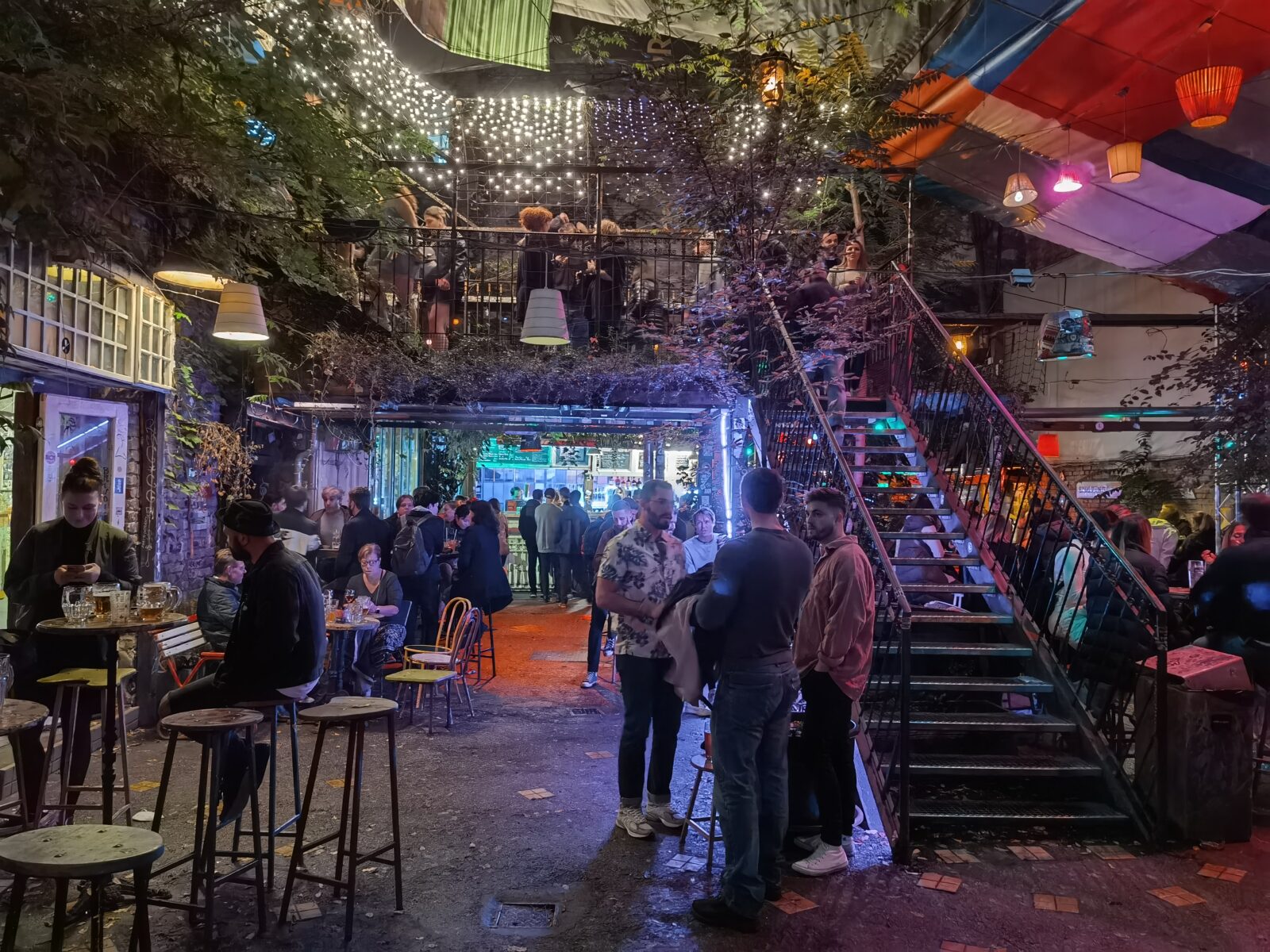
Budapest’s ruin bars (romkocsmák) started as an accident. In the early 2000s a handful of derelict courtyards in the old Jewish Quarter — District VII, emptied and left to crumble for decades — were furnished with kerbside junk and opened as cheap bars. Szimpla Kert did it first in 2004, and the look stuck: mismatched chairs, a bathtub sofa, plants climbing the walls. Two decades on, Szimpla is a bucket-list stop and the quarter has picked up its share of tourist traps. This guide, from the team behind Like A Local Tours, is about where Budapesters actually drink now. For everything beyond the bars, see our Budapest local guide.
Should you skip Szimpla Kert?
No — but time it. Szimpla Kert (ul. Kazinczy 14) is genuinely the one that started it all, and the sprawling two-storey courtyard, with its Trabant car full of seats and its dangling disco balls, is still a sight worth seeing. The trick is arriving early: come around opening or in the late afternoon and you can actually take it in. By 10pm it belongs to stag parties and pub crawls. Sunday mornings it flips into a laid-back farmers’ market, which is the most local Szimpla ever gets. It runs on walk-ins only — there are no reservations — and stays open until roughly 4am.
Where do locals go for a quiet drink?
Csendes — the name means “quiet” — sits just outside the Jewish Quarter near Astoria (ul. Ferenczy István 5) and is the ruin bar for people who want to hear each other talk. The walls are hung with mannequins, old toys, abstract drawings and century-old chandeliers; it is a mellow café by day and a candlelit wine bar after dark. Hours run Mon–Wed 10:00–24:00, Thu–Fri 10:00–02:00, Sat 12:00–02:00 and Sun 12:00–24:00. Come here when the party version of Budapest has worn you out.
What if you want a proper dinner with it?
Mazel Tov (ul. Akácfa 47) is the ruin bar that grew up. It keeps the derelict-courtyard bones but fills the space with hanging plants, string lights and a glass roof, and serves a full Middle Eastern menu — hummus, falafel, mezze, skewers — alongside a serious wine and cocktail list. Live jazz and Balkan brass most nights. It is deservedly popular, which means you need to book, ideally several days ahead; walking up on a weekend rarely works. This is the one to send friends who say they “don’t do ruin bars.”
Where’s the big all-night party?
If you came to Budapest to dance, go straight to the heart of District VII and Instant-Fogas (ul. Akácfa 49–51). When the neighbouring mega-bars Instant and Fogas merged in 2017 they became a single 1,200-square-metre complex — around 18 bars and seven dance floors under one roof, each room running a different sound, from rock to drum & bass. It is open daily 18:00–06:00, entry is usually free earlier in the night, and it is engineered so you never quite have to leave. Touristy? Yes. But locals still end big nights here because nothing else in the city runs this late at this scale.
Where do the ruin bars go in summer?
Outdoors, into a kert (garden). Kőleves Kert (ul. Kazinczy 37) is the best of them: a scrappy, leafy yard with hammocks slung under mulberry trees, red tin tables, draught beer, fröccs (the Hungarian wine spritzer locals live on in the heat) and grill snacks from a repurposed circus wagon. It only opens for the warm season — roughly May to September — and on a summer evening it is where the neighbourhood actually sits. If you are visiting in July, this is your spot.
What if you actually care about the beer?
Cross the ring road into District IX for Élesztő (ul. Tűzoltó 22). Set in a former glassworks, it was Budapest’s first craft-beer-focused ruin pub and still keeps around 30 taps — heavy on Hungarian breweries like Horizont, Fehér Nyúl and MONYO — plus a dedicated cask-ale bar and a wine room for the holdouts. The courtyard is all exposed brick and mismatched furniture, a little more industrial than the District VII gardens, and there is even a hostel upstairs if the beer wins. This is where Budapest’s beer people drink.
Where do locals go for live music?
Dürer Kert (Ajtósi Dürer sor 19–21), out by City Park, is less a ruin bar than a ruin-bar-grown-into-a-venue: a leafy open-air garden that doubles as one of the city’s most important live-music stages, with international gigs, underground DJ sets, craft fairs and art shows across the year and two indoor halls that keep it going through winter. Check what’s on before you go — on the right night it is the best value in Budapest.
How much does a night out cost — and where should you stay?
Budget roughly 1,200–2,000 HUF for a beer in a District VII ruin bar, a little less at quieter local spots and more at the polished end like Mazel Tov. Entry to the ruin bars themselves is generally free. One local rule: never follow someone who invites you into a bar off the street — that is the city’s classic overcharging scam, and it has nothing to do with the real ruin bars, which you walk into yourself. To stay in the middle of it all, Hotel Rum Budapest puts you a short walk from Kazinczy utca; for a daytime counterweight to all the late nights, our Communist Budapest & Memento Park tour is the classic morning-after outing. More ideas live in our Budapest markets guide, our take on a perfect Sunday in Budapest, and our guide to where to stay in Budapest.
Plan your Budapest night
See which beds sit closest to the ruin bars, and book a guided crawl if you’d rather be led — all on one map.
Find places to stay in BudapestBook a ruin bar tour
The booking links above are affiliate links: use them and we earn a small referral fee, while you pay exactly the same.