Quick answer: Budapest’s markets run on a weekly clock. The Great Market Hall (Nagyvásárcsarnok) at Fővám tér trades Monday to Saturday from 6am — go before 10am, and skip Sunday, when most of it is shut. Locals buy produce at the Fény utca and Lehel halls, hunt antiques at the Ecseri flea market (Saturday at dawn is the connoisseur’s slot), and finish the week at Szimpla Kert’s farmers market, Sundays 9am to 2pm.
In Budapest a market is not a photo stop; it is how the city eats. Paprika comes home by the tin, sour cherries by the kilo, and the week has a shape — grand halls on weekdays, the flea on Saturday, a farmers market under a ruin bar’s fairy lights on Sunday. For everything around the stalls, start with our Budapest local guide.
How do you beat the crowds at the Great Market Hall?
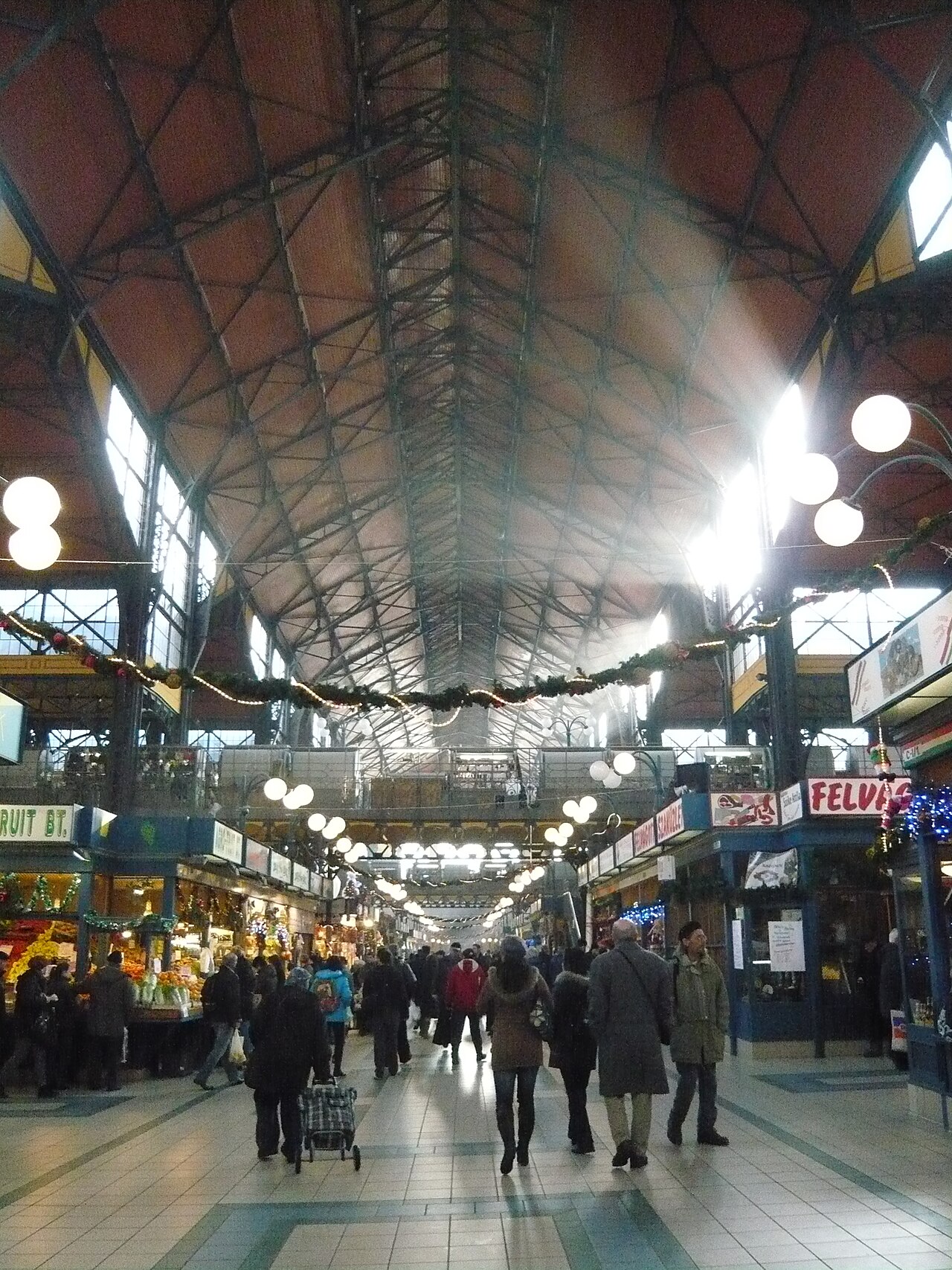
Arrive when the traders do. The Great Market Hall opened in February 1897 under a steel roof glazed with roughly 115,000 Zsolnay ceramic tiles from Pécs, and it remains the city’s grandest food building: three trading levels at the Pest foot of Liberty Bridge. Doors open at 6am Monday through Saturday (closing 5pm Monday, 6pm Tuesday to Friday, mid-afternoon Saturday), and the tour groups own the aisles by mid-morning — so the golden window is roughly 6am to 9.30am, when porters still outnumber phones. Do not build plans around Sunday; nearly everything stays dark.
Shop the building by level. The ground floor is for garlands of dried peppers, tins of paprika — édes is the sweet one, csípős bites back — whole Hungarian salamis and bottles of Tokaji. The basement handles the sharp end: barrels of savanyúság, Hungary’s beloved pickles, plus the fishmongers. The gallery upstairs fries lángos and sells embroidery; eat first, browse after. Then walk it all off across Liberty Bridge to the Gellért Thermal Baths, five minutes away.
Which halls do locals use for the weekly shop?
Mostly not the famous one. On the Buda side, the Fény utca market hides behind the Mammut shopping centre at Széll Kálmán tér and carries what may be the city’s best selection of organic and origin-protected Hungarian produce; it runs Monday 6.30am–5pm, Tuesday to Friday 6am–6pm and Saturday mornings until 1pm. Over in Pest, Lehel Csarnok at Lehel tér — one metro stop from Nyugati station — trades every single day: until 6pm on weekdays, 2pm on Saturday and, usefully, Sunday morning until 1pm. Prices at both undercut the Great Market Hall, and nobody will try to sell you a fridge magnet.
Is the Ecseri flea market worth the ride out?
If you like your treasure with a hunt attached, absolutely. Ecseri (Nagykőrösi út 156, District XIX) sits in Budapest’s south-east: take bus 54 or 55 from Boráros tér to the Használtcikk-piac stop, and the footbridge over the road lands you at the gate. Hours are 8am–4pm on weekdays, from around 5am to 3pm on Saturday and 8am–1pm on Sunday — and Saturday is the day, with the most sellers out and the serious buyers circling by sunrise. The stock runs from Herend and Zsolnay porcelain, folk embroidery and gramophones to Soviet cameras and communist-era badges. Bring forints in small notes and haggle with a smile; the first price is an opening bid, not a verdict.
Why is there a farmers market inside a ruin bar?
Because Szimpla Kert never wanted to be only a bar. Every Sunday since 2012, from 9am to 2pm, the mother of all ruin bars at Kazinczy utca 14 hands its courtyard to dozens of small producers selling raw honey, smoked sausage, goat cheese, sourdough and whatever the season allows. It is also your one chance to study the famous junk-decorated interior in daylight, coffee in hand, before the evening crowds reclaim it. For the after-dark version of the same street, there is our Budapest Ruin Bar Crawl; for the rest of a slow weekend, our guide to a perfect Sunday in Budapest picks up where the market ends.
Want the stories behind the stalls?
The Hungarian Food & Market Tour puts a local guide between you and the Great Market Hall’s counters and turns the morning into a proper tasting lunch — paprika, salami, lángos, cake and pálinka included. Still choosing a base? Where to stay in Budapest breaks down the districts, and the full Budapest city guide covers the baths, bridges and ruin bars in between.